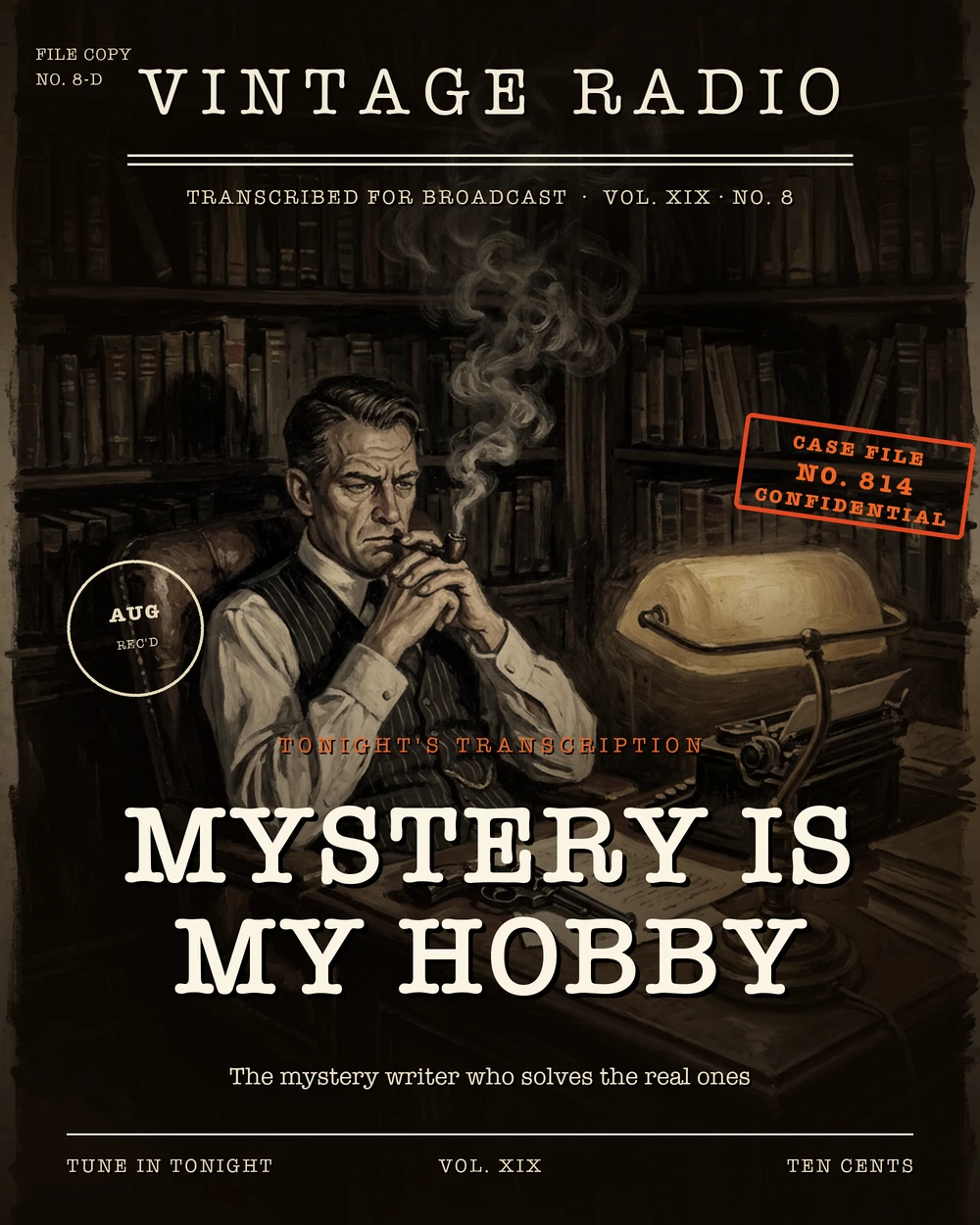
Mystery is My Hobby
How the Show Came Together
The show that became Mystery is My Hobby started life under a different name. On October 14, 1945, the Mutual Broadcasting System launched Murder Is My Hobby, carrying it on six Don Lee Pacific stations beginning in April of that year before the nationwide Mutual run got underway. The series ran on Mutual until July 14, 1946 — roughly 34 weeks. Rod O'Connor served as announcer during that original run, and Richard Wilkinson wrote the scripts.
The title change came about because of a sponsor. When the Benefit Life Insurance Company of Omaha, Nebraska came on board, they objected to the word "Murder" appearing in the name of a show they were paying to put on the air. That kind of sponsor pressure wasn't unusual in the 1940s, and the show's producers complied. The program was retitled Mystery Is My Hobby and later repackaged as a syndicated series that ran from 1949 to 1951. The overlap between the Mutual network run and the subsequent syndication packages has made precise episode counts and air dates genuinely difficult to pin down — various reference sources list the overall run as anywhere from 1945 to 1947, or 1945 to 1951.
Barton Drake, Gentleman Detective
The central figure is Barton Drake, a wealthy mystery writer who works alongside the police — described in the syndicated version as a man who solves crimes drawn directly from the pages of his own book, Mystery Is My Hobby. Each episode was framed as a case history: a typical opening ran, "For this week's drama I've selected Case History 127 from my book, Mystery Is My Hobby." At the close of every episode, Drake worked in his signature line — "Mystery is my hobby" — a catchphrase that gave the show its identity and its title.
Drake's recurring partner is Inspector Noah Danton, a police officer who teams up with Drake each week. Danton accompanies Drake even when cases take them out of the country, which gave the show some flexibility in its settings. The dynamic between the two — a literary amateur and a professional lawman — was a familiar radio structure, but the show leaned into Drake's gentlemanly, man-about-town quality. Stylistically, Drake sits closer to Lord Peter Wimsey than to the hard-boiled detectives like Sam Spade or Philip Marlowe who dominated so much of the radio crime landscape at the time. The show blended light humor with suspenseful storytelling and built its cases around quirky characters and unusual situations rather than street-level violence.
The program was performed before a live studio audience, which shaped its tone — the comedy landed differently in a room than it would have in a purely recorded production.
Glenn Langan in the Lead
Actor Glenn Langan, born July 8, 1917, played Barton Drake throughout the series. By the time he took the role, Langan already had stage and screen credits behind him. He made his Broadway debut in 1942, appearing opposite Luise Rainer in A Kiss for Cinderella, and signed with 20th Century-Fox in 1943. His Fox work during this period included Margie, Dragonwyck, and The Snake Pit — substantial productions that ran concurrently with his radio commitments.
Langan's radio work and his film career overlapped through most of the show's run. He's probably best remembered today for a film that came after — the 1957 science fiction picture The Amazing Colossal Man, in which he played the title role and which earned him a lasting cult following in that genre. He died on January 26, 1991, in Camarillo, California.
The Episodes in the Catalog
The ten episodes in the catalog all come from the syndicated version of the show and carry the Mystery Is My Hobby title. Because the show circulated in multiple syndication packages, establishing precise original air dates for individual episodes is difficult. The titles themselves give a fair sense of the show's register — "Death Buys Flowers," "Death is a Twin," "Death Writes an Epitaph," "Death Asks Questions," "Death Goes Before Pride," "Bullets Make Holes," "Mink Coat," "Murder Bound," "K.O. Brown," and "Case of 65 Women." The death-themed titles sit alongside more plainly pulpy ones, which reflects the show's mix of atmosphere and genre convention. None of them suggest the relentless grimness of the harder-boiled crime programs; these are puzzle stories with a stylish narrator at the center.
What the Show Was and Wasn't
One persistent error in older reference material is the claim that the show's lead character is named "Craig Rice." That name belongs to a real person — Georgiana Ann Randolph Craig, who wrote under the pen name Craig Rice and became famous enough to appear on the cover of Time magazine on January 28, 1946, the first mystery novelist ever to do so. She had no connection to this radio program. The confusion likely stems from the show's premise of a mystery writer-sleuth, which may have prompted someone to attach a well-known mystery writer's name to the character. The character's actual name is Barton Drake, and Glenn Langan played him throughout.
The show's original Mutual version cast Drake as a police inspector as well as a writer — a slightly different setup than the syndicated version, where the police connection is handled through his partnership with Noah Danton rather than through Drake holding a rank himself. That shift between versions is a small detail, but it reflects how shows adapted themselves when they moved from network to syndication.
Mystery Is My Hobby ran during a period when Crime-Detective programming was among the most reliable formats on American radio. It found its niche at the lighter, more cerebral end of that format — a show more interested in clever plotting and a charming lead than in the tougher, more violent style that defined some of its contemporaries.